
The term “high-tech innovation” now encompasses very different realities depending on whether we are talking about a consumer product or a system deployed in an industrial environment. An active noise-canceling headset and an autonomous logistics robot both fall under the category of “technology trends,” but their market launch constraints have almost nothing in common.
It is precisely this gap between the speed of innovation and the actual deployment capacity that shapes current high-tech trends.
Agentic AI: when artificial intelligence drives complete workflows
Generative AI produces text, images, or code on demand. Agentic AI, on the other hand, autonomously chains actions together: it uses tools, makes intermediate decisions, and orchestrates complete sequences without human intervention at each step.
McKinsey has included this category as a distinct trend in its 2026 overview, alongside AI applied to scientific discovery and engineering. The nuance matters: an AI agent does not just respond; it acts. In software development, this translates into assistants capable of fixing a bug, running associated tests, and submitting the modification for review, all without additional prompts.
This autonomy raises a direct question of responsibility. When an AI agent modifies a cascading production system, who validates the final decision? The answer is not yet stabilized, either technically or legally. Browsing Labo Linux’s high-tech articles allows you to follow these developments over time, with a focus on technical rather than marketing perspectives.
Cybersecurity of physical objects: the new attack surface
Technological risk analyses are no longer limited to servers and web applications. Electrical networks, satellites, industrial robots, and specialized chips are now documented targets. Cybersecurity is shifting to the physical world, and this migration changes the very nature of threats.
An IoT sensor installed on a production line does not present the same vulnerabilities as a cloud server. Its computing power is limited, updates are rare, and its lifecycle often exceeds that of the software that drives it. Attacks on this equipment do not aim to steal data but to disrupt a physical process: stopping an assembly line, skewing a temperature measurement, disorienting an autonomous vehicle.
Three criteria for assessing the exposure of a connected object
- The frequency of firmware updates: an object that has not received patches since its commissioning becomes a permanent entry point
- Network isolation: a sensor directly exposed on the company’s main network multiplies lateral attack paths
- The traceability of communications: without logging exchanges between the object and its server, detecting a compromise takes weeks or even months
The arrival of the Cyber Resilience Act in Europe introduces a logic of accelerated reporting of vulnerabilities for manufacturers of connected products. The text requires the notification of actively exploited flaws within short timeframes, which forces a rethink of the entire post-marketing follow-up chain.
Regulatory compliance in Europe: the real bottleneck for innovation
The pace of AI adoption in businesses is progressing faster than its governance. This gap is not trivial: it determines which innovations actually reach the field and which remain at the prototype stage.
In Europe, manufacturers of robots and embedded AI systems face an unprecedented regulatory stack. The AI Act, the Cyber Resilience Act, product liability rules, and the upcoming machinery regulation overlap, creating areas of legal uncertainty.
Compliance is becoming a major operational bottleneck for companies developing robotics or embedded AI. An autonomous delivery robot, for example, must simultaneously meet machine safety requirements, protect data captured by its cameras, ensure the cybersecurity of its communications, and maintain algorithmic transparency if its navigation system relies on machine learning.
What this concretely changes for businesses
The cost of compliance is not only measured in euros. It translates into extended time-to-market, legal teams mobilized before product development, and sometimes the outright abandonment of features deemed too risky to certify.
This situation creates a structural advantage for large groups capable of absorbing these costs, and a disadvantage for innovative SMEs that lack the necessary resources or regulatory expertise. Innovation is no longer just played out in the lab, but in the ability to navigate a fragmented legal framework.

Consumer products: audio, smart glasses, and smart home devices
On the consumer side, current tech trends focus on three particularly active segments: spatial audio, smart glasses, and smart home devices.
In audio, adaptive noise cancellation and hearing health tracking are transforming headphones into health sensors. Manufacturers are integrating measurement functions that far exceed music listening, positioning these products at the intersection of consumer electronics and wellness devices.
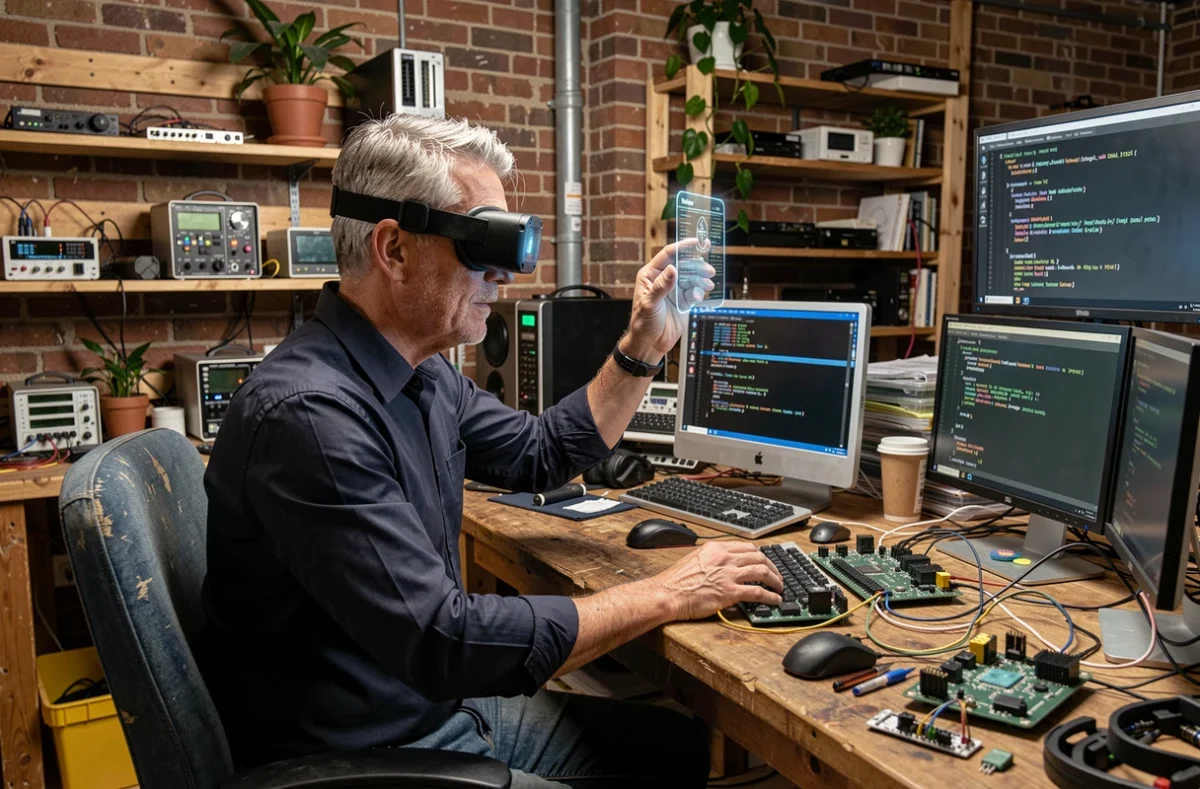
Smart glasses are progressing towards credible everyday uses. The miniaturization of optical components and improvements in battery life finally allow for extended usage sessions, far from the bulky prototypes of previous years. The heads-up display overlaid on the natural field of vision opens applications in navigation, instant translation, and professional assistance.
- Smart home devices are gaining interoperability through common protocols, reducing dependence on a single ecosystem
- Audio products are integrating biometric sensors (heart rate, temperature) that enrich their value proposition beyond sound
- Augmented reality glasses are now targeting prices compatible with broad adoption, not just early adopters
The issue of data collection by these devices remains the main friction point. A headset that measures heart rate or glasses that continuously film the environment generate sensitive data streams, subject to the same compliance requirements as the industrial systems mentioned earlier.
Current high-tech trends share a common trait: technology is advancing faster than the framework that is supposed to regulate it. Whether it’s agentic AI acting without human validation, physical connected objects exposed to unprecedented attacks, or glasses that continuously capture data, each innovation shifts complexity towards governance. The products that will sustainably prevail will be those whose manufacturers have solved this equation before going to market, not after.